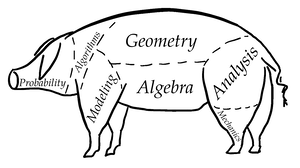
I study the relationship between abstract knowledge and the modern world. Combining historical, sociological, and other methods, I investigate how people produce such knowledge; how it derives from their social, political, and other contexts; and how they use that knowledge to shape those contexts in turn.
This topic has taken me to a wide range of subjects over the years, from dots and diagrams in sixteenth-century books, to mathematical rigor in the wake of the French Revolution, to Victorian anthropologists' attempts to understand the farthest reaches of prehistory by asking how civilizations learn to count, all the way to present-day mathematicians' efforts to collaborate using technologies as grand as the Internet and as mundane as chalk and blackboards.
Outside of my core research communities, I am best known for my work on the history and sociology of blackboards and for my revisionist history of the Fields Medal. My primary current research examines the globalization of modern mathematical research.
My research-led teaching emphases include the historiography of science in both its introductory undergraduate and postgraduate guises, and responsibility in mathematical research and professionalization.
Apologies this section is a bit messy and not completely up to date (ripped from my old website), a comprehensive revision is in progress!
The First Theory Born Global? Generalizations, particularities, and the places and relationships of modern mathematics. In Jemma Lorenat and François Lê (eds), History of Mathematics Beyond Case Studies, forthcoming.
This edited volume came out of a pair of symposia (online in 2021 and in Grenoble in 2022) organized by Jemma Lorenat and Catherine Goldstein on the history of mathematics "beyond case-studies", with François Lê taking over from Goldstein for the edited volume. I took this opportunity in conversation with many wonderful fellow historians of mathematics to elaborate and challenge the reasons why I have long been annoyed by historians describing their work as "case studies" and especially annoyed by others describing my work in those terms.
My chapter revisits a section of my PhD thesis on the multilayered construction of Laurent Schwartz's theory of distributions as a generalization establishing case-relationships among a number of mathematical concepts. I consider case historiography and its limitations, focusing on the problem of naturalism in the history of mathematics. I argue that particularization and generalization need to be properly understood as essential concerns of historical actors, concerns those actors share with the historians who aim to contextualize them. I conclude that if we must consider distributions as a "case" then it should be in the sense of a case of beer.
van Drimmelen, Tom, Jacqueline Thompson, Jennifer Ferrar, Sarahanne M Field, Bart Penders, Sarah de Rijcke, Marcus R Munafo, et al. Mapping Cross-disciplinary Perspectives on Responsible Conduct of Research: A Delphi Study. MetaArXiv, July 2, 2026. osf.io/preprints/metaarxiv/ukq73_v1
I participated in a large Delphi study of different disciplinary perspectives on responsible conduct of research, based on my experience teaching RCR to mathematicians. At the end, participants were invited to contribute to the manuscript and join as co-authors.
Alper, J., Barany, M., Chavarri Villarello, A., Dahmen, S., Dean, W., Ganapathy, K., Harris, M., Holmes, D., Jamnik, M., Kelk, S., Kra, B., Martin, U., Naskręcki, B., Ochigame, R., Portegies, J.& Schmitt, J. (2026). Leiden Declaration on Artificial Intelligence and Mathematics. https://doi.org/10.5281/zenodo.20302944
I was part of an international and multidisciplinary group aiming to promote productive engagement among mathematicians with artificial intelligence technologies in their discipline. We aimed to relate these technologies to mathematicians' values, institutions, and practices, especially related to publication and proving. The declaration website contains thousands of co-signatures as well as endorsements of major organisations and media coverage.
Trust in mathematics. RSE ReSourcE Magazine, Spring/Summer 2026, p. 8.
A short comment for a special issue on trust, invited as a member of the Young Academy of Scotland, the early/mid-career companion to the Royal Society of Edinburgh.
A very brief political history of American-hosted International Congresses of Mathematicians. Notices of the American Mathematical Society 73(4): 289-293.
Ahead of the 2026 International Congress of Mathematicians in Philadelphia, I was invited to write a short, accessible article for mathematicians on previous American-hosted ICMs. I included alongside the official American-hosted Congresses of 1950 (Harvard) and 1986 (Berkeley) some discussion of an alleged 1893 (Chicago) precursor to the ICMs as well as the failed American attempts to host ICMs in 1924 and 1940. The main goal was to show how these gatherings do indeed have political histories (indeed, rather significant ones!), notwithstanding their rhetorical commonplaces about apolitical inquiry and transcending political borders.
Review of: Ash, Modernism, modernity, and politics in the general history of science: implications of Herbert Mehrtens` work, from "Vienna 1900" to the Nazi era, and beyond. Science in Context 35(4), 2022, 336-350.
Review of: Kevin Lambert, Symbols and Things: Material Mathematics in the Eighteenth and Nineteenth Centuries. Pittsburgh: University of Pittsburgh Press, 2021.
Published in: British Journal for the History of Science. Pages forthcoming. Published online 23 September 2025.
Review of: Alma Steingart, Axiomatics: Mathematical Thought and High Modernism. Chicago: University of Chicago Press, 2023.
Published in: British Journal for the History of Science. Pages forthcoming. Published online 12 September 2025.
J.P. Ascher, Michael J. Barany, and Bo van Broekhoven, How to Read the Mathematics Index Cards. Part I: Locating. Part II: Managing. Rockefeller fellows: History of individual mobility awards at Rockefeller-endowed organizations, 1914-1970, ed. Pierre-Yves Saunier.
My research team has been a partner with a Swiss digital humanities project, heralds of globalization, to analyze the Rockefeller Foundation's fellowship index card files. We are examining the mathematics fellows, combining close reading, institutional history, and database methods. This two-part article for the project blog reports some of our initial analyses.
Reading Between the Lines in the Barany Lab: Lessons on Written and Unwritten Science and Mathematics. International Journal of Peptide Research and Therapeutics 31, art. 60. doi:10.1007/s10989-025-10721-2
I contributed this article to a special issue of IJPRT in honor of my dad's retirement.
Abstract. I reflect on my childhood experiences in the Barany Lab and connect them to several findings and themes from my subsequent career researching the history and culture of science and mathematics. Emphasizing the role of language and of written and unwritten aspects of science, together with their playful and communal characteristics, I connect George Barany's scientific perspectives to insights from my own fields of study. These insights include considerations of the formative role of wordplay, the multiple meanings of mathematical texts and practices, the role of blackboards in science, and misperceptions of the Fields Medal in mathematics. Focusing on written and unwritten play and imagination humanizes science and the communities that pursue it.
Contextualizing William Henry Young in Calcutta. Bhāvanā 9(3), July 2025, pp. 25-28.
For a series of reflections, contextualizations, and reprintings commemorating Raghavan Narasimhan's "Coming of Age of Mathematics in India," I wrote a short reflection on what the historical literature on Grace Chisholm Young and William Henry Young says about the latter's short stint in Calcutta.
Reply to H. Thorp, Convergence and consensus. Science, online, 28 May 2025. doi:10.1126/science.ady3211
Following some discussion on social media of Thorp's editorial, Greenwood organized a joint reply from the three of us, published as an eLetter. We argue that Thorp's focus on "convergent evidence" is misleading, and that "convergent understanding" better captures and communicates what Thorp aims to explain about what scientific consensus means.
Michael J. Barany and Brit Shields, Peter Lax, Pre-eminent Cold War Mathematician, Dies at 99. New York Times, 16 May 2025. In print 19 May, New York edition sec. B, p. 5.
This was my second collaboration with Brit Shields on an obituary for a legendary Courant Institute mathematician (see Louis Nirenberg, below). For this one, we had the advantage of pitching and writing before the subject's death. Already a nonagenarian when we started writing before the Covid pandemic, Lax did us the great courtesy of outliving our drawn-out editorial process, which concluded about half a year before he did.
Reviewing Lax's extraordinary life and career, it struck us that he exemplified (and often was at the forefront of) American mathematicians' complex engagement with the Cold War, which carried many costs and benefits. This theme could be found somewhat between the lines in the very useful biographical memoir by Lax's student Reuben Hersh, but had not been emphasized in the sources we consulted.
I met Lax and interviewed him at his home in New York City for my PhD research. We determined that his parents must have known my great grandfather in Budapest. His family came to New York City as refugees of the Second World War, while my father's family came to the same place as refugees of the Hungarian Revolution. Lax and my dad attended the same high school, some decades apart.
Review of: Haffner, Going to the source(s) of sources in mathematicians' drafts. Research in history and philosophy of mathematics—the CSHPM 2022 volume, Birkhäuser 2024, 83-110.
Review of: Hulek, Paniagua Taboada, Teschke, eds. 90 years of zbMATH. EMS, 2024.
Published in: Mathematische Semesterberichte 72, 177-179. doi:10.1007/s00591-025-00388-7
Review of: Roca-Rosell, Aldo Mieli (1879–1950) and the origin of the history of science in Spain: from the creation to the dissolution of the Spanish group. In foreign lands: the migration of scientists for political or economic reasons, ed. Borgato and Phili, Birkhauser, 2022, 291-307.
George Barany and Michael Barany, Foundational contributions of Svetlana Mojsov to the GLP-1 field. With George Barany. Exploration of Drug Science 2:688-700. doi:10.37349/eds.2024.00069
My dad's graduate school office-mate, Svetlana Mojsov, played an important and (until recently) frequently mischaracterized or overlooked role in the early biochemical science leading to GLP-1 agonist pharmaceutical therapies. My dad has recently put a lot of effort into correcting the record, and I have helped a little as a historian of science. This article started as his rebuttal of a number of prominent mischaracterizations of Mojsov's work, which we then rewrote collaboratively.
Review of: Lorenat, Relocating mathematics: a case of moving texts between the front and back of mathematics. Synthese 202(1), 2023.
Review of: Lê, The theory of algebraic surfaces in Mathematische Annalen seen from textometry (1869–1898). (La théorie des surfaces algébriques dans les Mathematische Annalen à l’épreuve de la textométrie (1869–1898).) Revue d'histoire des mathématiques 28(1), 2022, 1-45.
A Kaleidoscopic Introduction to the History of Science. Historical Studies in the Natural Sciences 54(1): 86-88. doi:10.1525/hsns.2024.54.1.86
This short article explains the design of my introductory History of Science course for a thematic section of HSNS edited by Melinda Baldwin and Brigid Vance on Pedagogy in the History of Science.
A "Truly International" Discipline: Adverbs, ideals, and the reinvention of international mathematics, 1920-1950. Isis 114(4), 791-816. doi:10.1086/727706
Zbl 08092923 MR4692787
This article presents one of the main arguments of my PhD thesis, revised through several years of further research. The argument started relatively early in my research with an observation about a rhetorical pattern in mid-century American mathematicians' discussions of international concerns, which led me to note in subsequent research whenever I encountered phrases such as "truly international" among mathematicians and their interlocutors. I used earlier versions of this article as a job application writing sample and essay prize submission, and after these uses had run their course I redeveloped the article for a general history of science journal readership.
Abstract: Examining how, and to what effect, the phrase “truly international” became central to the rhetoric and organization of the American-hosted 1950 International Congress of Mathematicians, I trace the negotiation of a "truly international" discipline from mathematicians' first international congresses around the turn of the century across two world wars and their divisive interlude. Two failed attempts to host International Congresses of Mathematicians in the United States, for 1924 and 1940, defined the stakes for those who became the principal organizers for 1950. Combining American organizational records with contexts and sources that extend across and beyond traditional mathematical centers in Europe and North America, I show how a small cohort of American mathematicians marshalled an emphatic but ambiguous "international" rhetoric to guide policies and command cooperation and support while responding to persistent challenges. Their adaptations and compromises left a lasting mark on the terms and achievements of international inclusion, cooperation, and hegemony in mathematics.
Une discipline "vraiment international": Adverbes, idéaux et la reinvention des mathématiques internationales (1920-1950). Trans. Pierre Verschueren. Le Monde des mathématiques, ed. Pierre-Michel Menger and Pierre Verschueren. Seuil, pp. 659-721.
Zbl 1545.01005 (book)
This edited volume started as a planned workshop at the Collège de France on mathematical communities and institutions, for which I had been invited to expand on some of my recent revisionist findings about the social and institutional history of the Fields Medal. Strikes and then a pandemic caused delays and then the cancellation of the workshop, but the edited volume still somehow came together and turned out to be really excellent.
My work-in-progress on "truly international" mathematical institutions ended up a better fit for the workshop and volume's framing, and I got permission from the Isis editors to develop a French derivative of the article eventually published around the same time in that journal. The parallel editorial processes for the journal and edited volume ended up pushing the versions in different directions in both substance and style, both rather successful in their own ways. Pierre Verschueren translated the result of a mostly anglophone revision process and made the French prose far more idiomatic and effective than I could possibly have managed myself.
The treachery of small numbers. The Sociological Review Magazine. doi:10.51428/tsr.igtz5084
This short essay aimed to raise in a playful and provocative style an accessible version of the Wittgensteinian argument from my Osiris article "On Remediation". Its success as a provocation is evidenced by the two letters to the editor (to which I was given some space to reply) submitted by senior Edinburgh colleagues of mine, both of whom managed inadvertently to illustrate some of the very phenomena at the heart of the essay.
Practice Makes Perfectoid: Pasts, futures, and the historiography of contemporary mathematics. Handbook of the History and Philosophy of Mathematical Practice, ed. Bharath Sriraman, section ed. Andrew Aberdein. Springer, 2619–2636. doi:10.1007/978-3-030-19071-2_83-1
MR4786463
I was initially invited by Andrew Aberdein to write up some of my philosophical disagreements with Viktor Blåsjö, an excellent mathematics historian with whom I have found it extraordinarily productive to disagree constructively, and who also wrote a chapter for this handbook. Some of that impetus remains in the conclusions, but I ended up using the opportunity to write up another product of fruitful disagreement (discussed in the chapter): an abortive collaboration with number theorist Michael Harris on the history of the perfectoid concept. I was grateful for the supportive setting for developing an argument through a dense weave of narrative play, and I think the result especially rewards readers on the lookout for this expository strategy.
Abstract: Comparing my historical account of the early years of Laurent Schwartz’s theory of distributions with number theorist Michael Harris’s narrative of the early years of Peter Scholze’s perfectoid theory, I develop a perspective on change and temporality in mathematics that emphasizes the relationships between concepts, expectations, and communities of practice. Contemporary mathematics, understood as mathematics imbued with temporality, reflects the dynamic relationship between the people, ideas, pasts, and prospects of mathematical knowledge. Studying these historically may offer critical perspectives on the social and political conditions and implications of mathematical research and the communities that practice it.
Michael J. Barany and Milena Kremakova, Inverting Hierarchies: The sociology of mathematical practice. Handbook of the History and Philosophy of Mathematical Practice, ed. Bharath Sriraman, section ed. Andrew Aberdein. Springer, 2597-2618. doi:10.1007/978-3-030-19071-2_87-1
MR4786462
This handbook chapter was a great chance to think through some major themes in the sociology of mathematical practice with Milena Kremakova, a sociologist of mathematics and labor with whom I had long hoped to collaborate. A highlight for me was working through some of the clichés in the literature about mathematics being a special or especially difficult subject for sociology, and the chapter opens by historicizing the relationship between sociology and mathematics across the history of the comparatively recent field of sociology. It was also important to me that we were able to spend some space on Kremakova's important unpublished research findings, which due to career circumstances was otherwise unlikely to be published soon.
Abstract: Sociology originated in the mid-nineteenth century from a new confidence in the power of science to explain the world on a mathematical foundation. Both mathematics and sociology transformed over the ensuing century, inverting the hierarchical relationship from sociology as a mathematics-based science of complex human configurations to mathematics as a complex science based on social institutions. That is, where sociology began as the hard case for mathematics, it became possible to see mathematics as the hard case for sociology. In this light, we examine a number of motivations and provocations for the sociology of mathematics, from language and social cognition to Marxist and materialist skepticism of ideology, and sample the evidence and arguments brought to bear on the sociology of mathematics at a range of scales.
On Remediation: Media, repair, and the discipline of fantasy in the theory and practice of algorithmic modernity. Osiris 38: 40-57. doi:10.1086/725090
This article was part of the 2023 Osiris volume "Beyond Craft and Code," edited by Adrian Johns and James Evans, aiming to revisit and reimagine the controlling metaphors of the history of algorithms. I developed the argument through a 2018 workshop hosted by the editors and a brief residency in 2019 at the Franke Institute for the Humanities at the University of Chicago.
Abstract: Nothing ever works quite as imagined. This truism, based in fundamental features of both work and imagination, raises vital questions about mediated metaphors and practices of enacting and enforcing theoretical fantasies about algorithmic systems and systematic mathematical knowledge. Methods of moving conceptual figurations between media—such as blackboards or printed paper—as well as explicit and implicit ideas about such transmutation in conceptual practice, suggest the thoroughgoing importance of remediation: repair, correction, backfilling, but also (as a pun) patterns of mediation and transit across material manifestations. Such remedial work links algorithmic practice and fantasy from early modernity to the present, from the elementary to the elite. Remediation appears in deliberate theories and practices of error detection and correction, as well as in habituated modes of conceiving of and intervening in large conceptual systems characteristic of modern algorithmic and mathematical thought and action. I explore these here episodically, elaborating an account of remediation and algorithms through analyses of sixteenth century arithmetic, nineteenth century blackboard practice, and twentieth century efforts to establish global institutions and universal foundations, concluding with two twenty-first century episodes that illustrate some present stakes of this analysis.
The Interwar World, ed. Andrew Denning and Heidi Tworek. Routledge, pp. 442-458. ISBN 9780367616847 (hard) ISBN 9780367616854 (soft) ISBN 9781003105992 (electronic)
Emily Kern and I collaborated on a thematic chapter about "Natural Sciences" for a large edited volume reconsidering the historiography, geography, and periodization of the "Interwar World". We took the historiographical emphasis on the problem of German science as a way into the literature on internationalism, atomic sciences, imperial and colonial sciences, eugenics, and national institutionalization.
Review of: Høyrup, Fifteenth-century Italian symbolic algebraic calculation with four and five unknowns. Gaṇita-Bhāratī 42, 2020, 55-86.
Review of: Friedman, Metaphorical reactions in 1932: from the mathematical `crisis of intuition' to `reconstruction in the exact sciences'. British Journal for the History of Mathematics 37(2), 2022, 138-161.
Placing a Global Mathematical Literature: Geography, Infrastructure, and Information in the Mid-Century Zentralblatt für Mathematik and Mathematical Reviews. Research in History and Philosophy of Mathematics: The CSHPM 2021 Volume, ed. Maria Zack and David Waszek. Springer, pp. 199-212. doi:10.1007/978-3-031-21494-3_12
Zbl 1567.01014 MR4633164
Abstract: The problem of comprehensive and timely mathematical bibliography was at the forefront of mathematicians’ international and global ambitions in the twentieth century. The Zentralblatt für Mathematik und ihre Grenzgebiete and its slightly younger counterpart Mathematical Reviews formed a lynchpin for a widely distributed publishing infrastructure that created a meaningfully global mathematical literature, changing in the process how mathematicians organized their research communities and their ideas alike. This chapter examines how geographic markers of place appear and recede from view in these review journals and their operating apparatus. Combining evidence from comparatively central and peripheral locations and institutions, it shows how tracking the changing visibility and salience of specific locations can help to situate and historicize instruments and practices of connection-making and decontextualization at the root of modern mathematics.
'Some call it Arsmetrike, and some Awgryme': Misprision and precision in algorithmic thinking and learning in 1543 and beyond. Algorithmic Modernity: Mechanizing Thought and Action, 1500-2000, ed. Morgan Ames and Massimo Mazzotti. Oxford, pp. 31-44. doi:10.1093/oso/9780197502426.003.0003
MR4581407
This edited volume grew out of a 2017 workshop at Berkeley examining algorithmic thinking across the early modern and modern periods. I aimed to recover a view of algorithms from before the seventeenth century, where algorithms were not understood to be mechanical, deterministic, or certain. I am pleased to have featured 'Farting for Modernity' as a section title, and to have supplied a substantive scholarly argument to justify this.
Abstract: Algorithms found significant new audiences in early modern mathematical pedagogy through vernacular arithmetics like Robert Recorde’s 1543 Ground of Artes. Recorde presented rule-based algorithmic methods as powerful but error-prone, requiring practice and expertise to apply effectively. This view of algorithms is apparent in Recorde’s exposition through pedagogical dialogue, with a frequently erring Scholar continually corrected by a learned Master. In contrast to later mechanistic views of algorithms, sixteenth-century algorithmic thinking reflected experience and discernment, not just in the manipulation of numbers but in the contextual appreciation of mathematical knowledge. This chapter explores these aspects of early modern algorithmic thinking through a close reading of Recorde’s presentation of long division, framed by Recorde’s discussion of the terminology of arithmetic and algorism, and concludes with a meditation on farts and algorithmic modernity.
Review of: Beeley, Nasifoglu, and Wardhaugh, eds., Reading mathematics in early modern Europe. Routledge, 2021.
Published in: The Seventeenth Century 38:5, 922-924, doi:10.1080/0268117X.2023.2240617
Review of: Ackerberg-Hastings, AWM in context: comparing the histories of professional societies for women in STEM. Fifty Years of Women in Mathematics, ed. Beery, Greenwald, Kessel. Birkhauser, 2022, 975-985.
Review of: Review of Netz, A New History of Greek Mathematics, Cambridge 2022.
Published in: The vexing problem of ancient Greek mathematics. The Spectator Magazine, 4 February.
Excerpt: The most important thing to know about ancient Greek mathematics is how little anyone knows about it. The scant evidence available today is tremendously indirect: reconstructions from unrepresentative survivals of fragments of translations of transcriptions of commentaries on compilations of summaries of allusions to refutations of excerpts of documents produced as part of an oral culture of learning in which the original writing may never have been expected to encapsulate what really mattered. … Every generation rewrites the knowledge of its forebears, and Greek mathematics has been rewritten by more generations than it's even possible to identify. …
Nombrar y traducir: Redes y organizaciones mundiales de la matemática en el siglo XX. Políticas de la Ciencia, ed. Mandressi and Markarian. Universidad de la República, pp. 175-186. .
This edited volume chapter summarizes some of my work on language, bureaucracy, funding, and international scholarship in mathematics.
Mathematical Institutions and the 'In' of the Association for Women in Mathematics. Fifty Years of Women in Mathematics, ed. Beery, Greenwald, and Kessel. Springer, pp. 325-341.
Zbl 1510.01059, MR4454631
I wrote this invited book chapter for a large edited volume celebrating the fiftieth anniversary of the Association for Women in Mathematics. In addition to summarizing some of my own relevant research and surveying work of others that contextualizes the AWM, I elaborated on two key findings that I had only briefly mentioned in other publications: on the role of secretaries and their gendered labor in mathematical institutions, and on the near miss of Olga Ladyzhenskaya for the 1958 Fields Medal.
Abstract. From its founding, the Association for Women in Mathematics paid special attention to the difference made by specific prepositions, and the associated nouns and verbs they bring into play. This chapter focuses on the AWM’s second preposition, and what it means to be “in” mathematics. Women have been doing mathematics—learning, teaching, creating, enjoying, applying, and more—for as long as there has been mathematics. Yet they have only sometimes in this history been doing so from within, as recognized and validated participants in mathematics as an organized collective endeavor. This chapter examines some of the history of women in mathematics and of women being tacitly or explicitly kept out of mathematics, mostly from before the AWM’s founding. It shows the importance of the institutional history of mathematics for understanding the history of women’s participation in and exclusion from the discipline and the significance of the AWM in light of this history.
Review of: Carman, François Viète's method for calculating the eccentricity in a bisected model and its possible application to Kepler's vicarious hypothesis. Historia Mathematica 58, 2022, 71-91.
Review of: Ehrhardt, Concrete history of abstraction and history of mathematics. Revue de Synthèse 142, 2021, 434-465.
Review of: Hollings and Siegmund-Schultze (with Kragh Sørensen), Meeting under the integral sign? The Oslo congress of mathematicians on the eve of the Second World War. American Mathematical Society, 2020.
Review of: Cerroni and Brigaglia, The ``Circolo Matematico di Palermo'' and the First World War: the crisis of scientific internationalism: a view through the unedited correspondence of De Franchis with Edmund Landau and other mathematicians. Historia Mathematica 55, 2021, 64-94.
Review of: Netuka, Lebesgue’s criticism of Carl Neumann’s method in potential theory. Archive for History of Exact Sciences 74, 2020, 77-108.
Here are some recordings of me presenting academic things, available on the open internet. See also the next section for some recorded interviews.
I gave an "onboarding" talk on social studies of mathematics as part of a Lorentz Center workshop on Mechanization and Mathematical Research. The talk introduced terminology and approaches to be used throughout the week-long interdisciplinary workshop. While talks were not recorded, participants were encouraged to share lecture notes or slides. I gave a chalk talk (this helped me make an analytic point about mathematical communication media, among other reasons!), so only have lecture notes, which I elaborated after the fact, including adding links to some of my relevant publications.
I was an invited speaker for the closing workshop of the Isaac Newton Institute's 2025 semester on Modern History of Mathematics. My SIGMA research team participated extensively in the semester, with the two project postdocs in residence for most of the programme. Talks at the closing workshop were meant to outline research agendas that take forward the research from the INI semester. I gave another chalk talk, following the success of my Sociable Structuralism presentation earlier in the semester, and resolved thenceforth to move away from slideshows where blackboards were available.
Abstract. I will motivate and lay out some methods and a research agenda for examining and explaining the situatedness of modern and contemporary mathematics, together with their scales and interconnections. Recent seemingly-global mathematics is a recent, contingent, and precarious phenomenon whose historicization requires new approaches and insights. My research team is currently working on these challenges through a UKRI-funded project Situating International and Global Mathematics.
I was an invited speaker for a mini-workshop on the history of mathematical structures organized by Rebecca Waldecker and Volker Remmert in the middle of the 2025 Isaac Newton Institute semester on Modern History of Mathematics. I gave a chalk talk in homage to the INI's famous blackboard-centric culture and design, including blackboards in washrooms and novelty blackboard mugs given to workshop participants.
Abstract. I will survey several results from recent research and some ongoing lines of inquiry into the social, material, and institutional history of structuralisms in mid-century mathematics. I contend that the restructuring of mid-century mathematics rested on a pliable homology between new and renewed ways of organising mathematical concepts, documents, places, funds, and people. This homology underwrote productive sociabilities across multiple scales and contexts of mathematical research. My argument connects Bourbaki, mathematical abstracting, 'circumknowing' in scientific funding, and other 'structural' elements of this distinctive and transformative period.
I was the guest speaker for the 2023 AGM of the UCU Scotland Retired Members' Branch and enjoyed an energetic discussion of Scottish university governance starting off with my experience attempting to mobilize at-large members of the University of Edinburgh Academic Senate.
Online Topos Institute Colloquium introducing my work on the history of mathematical institutions and infrastructures to a largely mathematical audience interested very broadly in mathematical structures.
[full title] How Categories Come to Matter: On the history and sociology of categories in modern mathematics.
Abstract. I will situate categories and related mathematical principles in the history of modern mathematics from the late nineteenth century to the present. The worldviews and perspectives adopted by the Topos Institute derive from specific transformations in the nature and scale of mathematical research over the last century-and-a-bit. These connect the ideas of modern mathematics to its people, institutions, and infrastructures. I will consider two main senses in which categories "come to matter": first, how categories of various kinds became meaningful, salient, and important as ways of seeing the mathematical world and and the worlds of mathematicians; and second, how such categories were encoded, translated, reproduced, and made to move on and across various kinds of material media (i.e. physical matter) such as blackboards, index cards, and printed journals. I contend that these two senses are historically connected, in ways that relate to the continuing goals and challenges of the Topos community.
For the Royal Historical Society's New to Teaching workshop, I offered some advice and provocations about module design based on my experience with introductory History of Science teaching.
I was pleased to join the online seminar series Talk Math With Your Friends, an outgrowth of the pandemic lockdowns that remained a lovely forum for talking about mathematics for a while after the lockdowns ended.
Abstract. Today, it is ordinary and in many cases expected for mathematicians to engage with work and people from other countries and often other continents. Mathematicians often travel long distances for their vocation, and it is not unusual for careers to be built through international migration. I will identify Global Mathematics as a distinct historical phenomenon in the modern history of mathematics and argue that it should be understood as a recent, provisional, contingent, and precarious development, explaining in the process what makes this argument significant for historians of mathematics. Global Mathematics today is threatened by disease, climate change, geopolitics, racism, economic disparities, shifting assumptions about mathematics and higher education, and numerous other recent and long-running considerations. Asking why mathematicians have aspired (and continue to aspire) to make and maintain global connections and what their efforts to achieve this aspiration have cost (and continue to cost) the mathematics profession and its surrounding societies, I will challenge the TMWYF community to reconsider the values and implications of Global Mathematics in the past, present, and future.
I joined the Sociedade Brasileira de Lógica (Brazilian Logic Society) pandemic lockdown seminar series Lógicos em Quarentena to talk about the history behind calls to boycott the then-upcoming Russian 2022 International Congress of Mathematicians.
[full title] "Attempts to link scientific activities to political and societal issues": Boycotts, politics, and the creation of the International Mathematical Union.
Abstract. In response to calls to boycott the upcoming 2022 International Congress of Mathematicians, the International Mathematical Union Executive Committee issued a statement on 21 February of this year "oppos[ing] all boycotts of scientific events and all attempts to link scientific activities to political and societal issues." To the contrary, the history of the IMU has fundamentally been about the inextricable links between mathematics and politics. I will survey how "attempts to link scientific activities to political and societal issues" have been central to the IMU from its origins. These attempts included calls for a boycott of the 1950 International Congress of Mathematicians that were joined by the postwar IMU's first president and that decisively shaped the IMU's organization and history. I will examine the causes and consequences of the 1950 boycott effort and then close with some lessons and implications for today's IMU and the calls for a 2022 ICM boycott.
As a new member of academic staff at the University of Edinburgh, I introduced some of my research at the annual retreat of the Institute for the Study of Science, Technology and Innovation, a research network connected to my department.
I participated in an experimental workshop of the Observational Practices Lab (Parsons School of Design), titled Object America, where people from different fields shared methods for observing the same object, a Bell System 500 rotary telephone. The Object America website link for the recording also has an edited transcript including some of the observation images I sent in advance of the workshop. This turned out to be a turning point for my own thinking about inventory as a critical method, which has become important in both my teaching and research in the years since the workshop.
This is a recording of my talk at the Mathematical Cultures 3 conference organized by Brendan Larvor at the London Mathematical Society. I presented some early findings from my PhD research on mathematicians' mid-century funding, focusing on how American mathematicians justified themselves to philanthropic, corporate, military, and other sponsors. Several revisions later, this became the chapter Remunerative Combinatorics noted above in the conference proceedings edited volume.
Here are some links to interviews and other works featuring my work:
Ahead of a major auction of materials associated with James Stirling, the auction house Lyon and Turnbull invited me for a chat. Cathy Tait (head of rare books and manuscripts) and I discussed a variety of items from the auction, from books and manuscripts to letters to a brass waywiser. I was a keynote speaker for the 2024 Beyond Europe conference (theme: AI in International Relations and Communication), part of a largely student-led annual series based in the Faculty of Political Science and Journalism of Adam Mickiewicz University, Poznan, Poland. The keynote presentation itself (Artifice and Intelligence in Global Science and Education) was not recorded, but my student host Ellias Aghili Dehnavi recorded a short interview for posterity. For a blog series on university governance, I spoke with Sean McMahon for the Council for the Defence of British Universities about my work on the University of Edinburgh Academic Senate. I was invited for an email interview by the youth mathematics program that gave me my start in university mathematics. Victor Monnin interviewed co-editor Kirsti Niskanen and me about our edited volume. We talk about the book's origin and arguments, as well as its contexts including persona studies, history of science, gender history, institutional history, and feminist history. The interview is part of the New Books Network academic podcast consortium, and appeared in the History of Science and several other channels.
I started listening to Scott Knowles's essential disaster studies podcast early in the COVID lockdowns, and a year later joined to talk about mathematics research and education. On Lamb and Knudson's mathematics podcast, guests choose a favorite theorem and a pairing to go with it. I talked about the theory of distributions (and the theorem that integration by parts works how it ought to work for distributional derivatives), paired with knock-knock jokes. I also tried to explain a bit about history of mathematics as a field, and discussed my work on the Fields Medal. Ben Orlin very skilfully condensed and cheekily illustrated an interview about my revisionist history of the Fields Medal. Published on Orlin's Math With Bad Drawings blog, 25 July 2018. I published some major revisionist findings about the history of the Fields Medal in Nature in 2018. Before Nature was confirmed as the outlet for this, I was also in touch with Science, whose physical sciences editor ended up commissioning a reporter to cover my report as news. 16 January 2018. doi: 10.1126/science.aat0261 As a short-lived get-to-know-you feature for Dartmouth College, a handful of postdocs were profiled with a "Proust" questionnaire. I was one of them. Shortly after I arrived in New Hampshire for my postdoc at Dartmouth College, I was approached by a science reporter for a nearby newspaper and had a delightful conversation about my research on mathematicians and blackboards. 3 January 2017. Brooks discussed the story on local public radio [NHPR].
My research on blackboards was picked up by Improbable Research in 2016 and later appeared on their podcast in 2021. I don't know whether that makes me an IgNobel nominee, but it definitely got my article some new readers. Uruguayan mathematician José Luis Massera emerged as a key figure early in my PhD research, and I ended up following his paper trail from the Rockefeller Foundation to his university in Uruguay to the United States Federal Bureau of Investigation and beyond. A research contact in Montevideo connected me to a journalist interested in Massera's story and drew on many of my initial findings for this story. 1 June 2015. Cornell University's Mathematics Department put together a retrospective on its undergraduate majors, including invited reflections from a number of recent graduates. I was the featured graduate for my year (2008). I was not sure how much to write in response to their prompt, and the fairly short excerpt they published might make more sense in the context of the full reflection. I grew up in and around the University of Minnesota, and that is where I got most of my mathematics education from pre-algebra enrichment events to my first courses in combinatorics and real analysis. It was in these latter courses that I first encountered the Cornell mathematics department in the form of the Way of Analysis textbook by Bob Strichartz, which my professor at Minnesota was trying out for the first time. One of my first appointments after arriving on campus for my freshman year was to meet Professor Strichartz in his "outdoor office," which consisted of a pair of folding chairs just off the path through the A.D. White Garden, which sat between the Math Department and the headquarters of the Society for the Humanities. I had come to Cornell for three main reasons. The first was to live in the Telluride House, a multi-disciplinary self-governing community of undergraduate and graduate students and a few professors; several of my mathematics classmates and three of my professors from the department were guests there for various events (or, for the former, for working on problem sets). The second was because, having studied so much mathematics at Minnesota and wanting to continue in the field in college, I needed to be somewhere with a reasonably large mathematics department with good offerings for undergraduates. Lastly, I did not want to study only mathematics, and Cornell seemed like a place where I could take mathematics very seriously without taking other fields less so. The main purpose of my meeting with Professor Strichartz was to talk about taking his graduate course in real analysis that semester, which I ended up taking (along with its complex analysis counterpart) alongside the demanding honors undergraduate algebra sequence taught by Professors Sjamaar and Dennis that year, after winning the consent of my freshman advisor—who happened to be John Hubbard—in part by solving a few math problems in his office. Some induction to college! That year of math classes was definitely challenging, but I was glad to be in a supportive department willing to let me try. The following summer I got my first real taste of research on open mathematics problems in Professor Strichartz's REU on differential equations on fractals. I found in the mathematics department ample confirmation of my second reason for coming to Cornell, but also a refreshing encouragement, both in the interests demonstrated and the advice they gave, for the third reason. The summer after my second year was spent at the School of Criticism and Theory, whose headquarters were across the garden from the math department in the A.D. White House. When I declared a second major in the College Scholar program on the History, Sociology, and Philosophy of Mathematics, Professor Strichartz was happy to join my thesis committee. I started graduate school with the intention of continuing on this dual course, which had felt so appropriate and feasible at Cornell. Now, as I approach the end of my PhD in Princeton's Program in History of Science, my research is solidly in the field of history. But it relies centrally on my mathematics education from Cornell. In my notebook from that first graduate class in real analysis at Cornell, my jottings from the first day include references to the famous Princeton historian and philosopher of science Thomas Kuhn and to two major historical developments that Professor Strichartz suggested Kuhn's work might explain: Lebesgue's theory of integration and Schwartz's theory of distributions. The latter is now the topic of my PhD dissertation.
The Library of James Stirling, Mathematician (2025). [L&T] [youtube]
AI in International Relations (2024). [youtube]
Towards collective academic governance at Edinburgh. Sean McMahon (2023). [CDBU]
UMTYMP Alumni Profile (2023). [umn.edu]
Gender, Embodiment, and the History of the Scholarly Persona. Victor Monnin (2023). [NBN]
COVIDCalls 255 - Mathematics and the Pandemic. Scott Knowles (2021). [youtube] [podbean]
My Favorite Theorem. Evelyn Lamb and Kevin Knudson (2020). [kpknudson.com]
The Forgotten Dream of the Fields Medal. Ben Orlin (2018). [MWBD Blog]
The Fields Medal was never meant for `the greatest mathematical genius.' Michael Price (2018). [Science]
Postdoc Proust (2017) [Dartmouth]
Mathematicians love their blackboards. David Brooks (2017) [Concord Monitor]
Chalk, for the Mathematician (2016). [Improbable]
Matematico Massera fue investigado por el FBI. Eduardo Delgado (2015) [El País]
Cornell Mathematics Majors (2014). [math.cornell.edu]
Expand to read the full reflection …
During a lively conversation at a conference I recalled a quote attributed to Joseph-Louis Lagrange and an inspired interlocutor said that would make a great t-shirt. So I drew up a design, and you can now find the quote on a range of products here, in English or French. If these do not meet your needs, please get in touch about a custom version.
Despite my rank amateurism as a graphic designer, this little project has sold rather more copies, and made rather more people happy, than most of my professional academic work.